
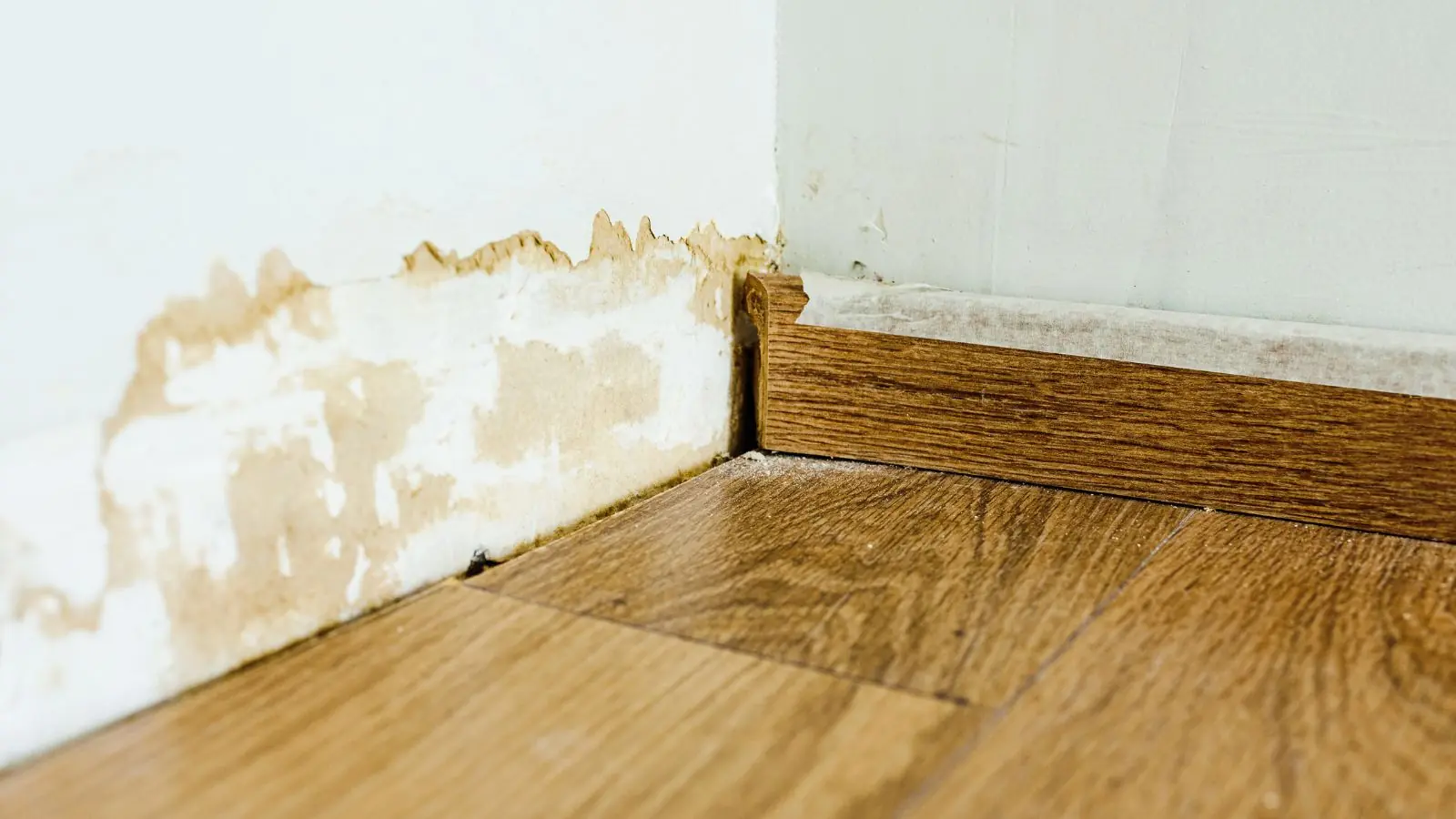
A wall can fail in several ways after a leak. The paint blisters, the seams open, the baseboard lifts, or the board turns soft and crumbles. Each sign says something different about how long the wall was wet and how far the water went, and the repair depends on that answer.
This guide assumes the leak is fixed and the wall is no longer being wetted. If you are not sure, a moisture reading comes first, as the water mitigation page explains.
Judge the damage
| Wall condition | Likely cause | Repair level |
|---|---|---|
| Light stain, firm board | Brief wetting that dried | Prime and paint after confirming dryness |
| Bubbling paint, firm board | Moisture behind the paint | Open, dry and repaint |
| Soft or crumbling board | Long or repeated wetting | Cut out and replace the section |
| Mold or heavy odor | Moisture feeding growth | Stop and request an assessment |
Open the wall and look inside
Cut out the damaged board back to dry studs, using a utility knife and a drywall saw, and keep the cuts straight so the patch fits. Turn off power to the area first and check for wires and pipes before cutting. Wet insulation should be removed because it holds water against the framing.
Look at the studs and bottom plate. Dark staining, soft wood or fuzzy growth means more moisture than you thought. Let the cavity dry fully, with a fan and dehumidifier, before closing it.
Patch, tape and finish
Replace insulation
Install fresh insulation once the cavity reads dry.
Hang board
Cut a patch that spans stud to stud and screw it in.
Tape and mud
Cover seams with tape and joint compound, sanding between coats.
Prime and paint
Use stain-blocking primer, then paint the whole wall for a clean finish.
Matching texture is the hardest part. Spray texture on older walls can be matched with a can of the same type, but a faint patch is common. Painting the whole wall to the corner hides it far better than a spot repair.
San Pedro note: permits and who to ask
The Los Angeles Department of Building and Safety oversees construction in the city of Los Angeles, including San Pedro, and handles plan review, permitting and inspections. It publishes electrical and plumbing code information bulletins on its site.
A drywall patch alone may not need a permit, but opening walls to repair plumbing or electrical often does, so ask the department before you start. Having the answer in writing protects you when you sell or file an insurance claim.
When a wall is not a DIY job
Call a crew if the water was contaminated, if the wet area is larger than a few square feet, if mold is visible or if there are signs of structural damage such as sagging. A crew can read moisture, dry the cavity properly and provide a written scope that supports an insurance claim.
The same logic applies in hillside homes in Rancho Palos Verdes and houses in Torrance. After drying, water damage repair rebuilds the wall, and cleanup handles the debris.
Matching the finish
The repair that people notice is the finish, not the board. Feather the joint compound several inches past the patch, sand lightly between coats and prime the whole patch with a stain-blocking primer. Texture should be matched before paint, and painting the full wall from corner to corner hides a seam better than a small spot.
Allow each coat to dry fully. In a damp room, a coat that looks dry can still hold moisture, and paint applied early may blister weeks later. If a patch bubbles, the wall is probably not dry yet.
Tools and supplies to have ready
- A moisture meter or a borrowed reading from a crew.
- A utility knife, drywall saw and a straight edge.
- Joint compound, tape and fine sanding sponges.
- Stain-blocking primer and matching paint.
- A respirator, goggles and drop cloths.
When a wall is not a DIY job
Call a crew if the wall stays damp, if insulation is wet, if a stain keeps returning or if you suspect a leaking pipe inside the wall. A repair over a wet cavity fails. A crew can dry it, confirm the readings and hand it back for finishing.
Walls in older multi-unit buildings often share plumbing with the neighbor, so a stain on your side may have a cause on theirs. Tell the manager early and keep photos with dates.
Work in good light and step back often. Raking light from a lamp held low across the wall shows ridges and low spots that flat light hides, and it is the easiest way to judge sanding before you prime.
Not sure whether the wall is dry? Call and ask about moisture readings before you close it up.
☎ Call (424) 550-5662Questions about wall repair
How do I know whether wet drywall can be saved?
If it is firm and dries completely, it can often stay. Soft, crumbling or moldy board should be replaced.
Do I need to replace insulation?
Wet insulation holds water against framing and should usually be replaced.
Does a San Pedro home need a permit for a drywall patch?
A small patch may not, but plumbing and electrical work often does. Ask the Department of Building and Safety.
Why does my patch show through paint?
Texture and sheen differ. Painting the whole wall and using a matching primer reduces the line.
Can I repair a wall in a rental?
Tell your landlord first. Repairs to the building belong to the owner under most leases.